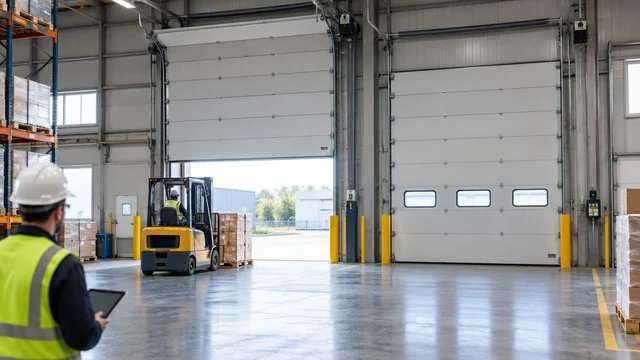
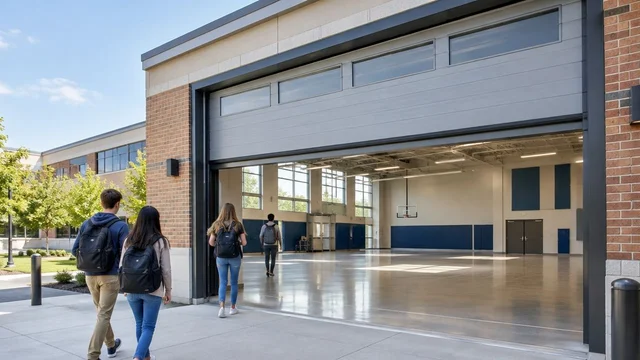
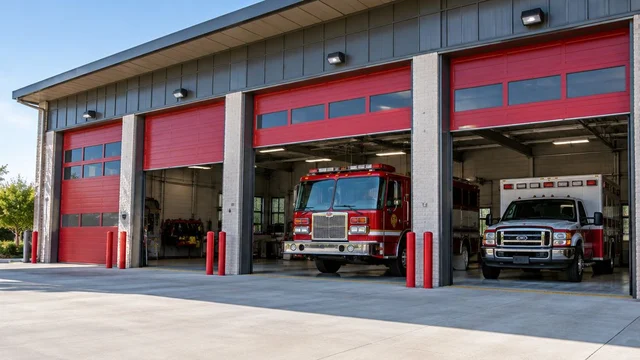
Stop operating your Louisville garage door if it will not move, keep people clear, and check only accessible controls and visible obstructions from a safe position. A door that hangs crooked, has a loose cable, or appears to have a broken spring needs professional repair—not another opener attempt. If someone is injured or trapped, contact emergency services rather than waiting for a garage door appointment.
TL;DR
- Emergency garage door repair Louisville starts with stopping operation and keeping people clear of the stuck door.
- Derby Strong provides garage door repair and opener service for Louisville homeowners and businesses.
- Crooked doors, loose cables, and damaged springs require professional service, not homeowner adjustment.
- Check accessible controls only when the door is stable and no mechanical damage is visible.
Why This Matters for Your Door
A stuck garage door creates two separate problems: lost access and possible mechanical danger. Treat the danger first. Repeated button presses do not establish whether the fault is electrical, mechanical, or an obstruction, and they can keep a damaged system under load.
Derby Strong provides garage door repair and opener service for Louisville homeowners and businesses. When you arrange service with Derby Strong, describe the door’s position and visible damage before asking about the opener. A door stuck closed and a door hanging unevenly need different handling.
What should you do when your Louisville garage door will not move?
Start with observations you can make without touching the door, climbing, or entering its travel path. A visible mechanical fault ends the homeowner checklist. Do not continue testing just because the remote still activates the motor.
Stop operation
Release the wall control and stop using the remote. Keep children, pets, customers, and vehicles away from the opening, including the area directly beneath a partly open door.
If the door is moving unpredictably, keep your distance. Do not reach for the emergency-release cord, try to catch a falling section, or move a vehicle through a narrowing opening. A vehicle trapped inside is an access problem; it is not a reason to take a lifting risk.
Observe safely
Look from outside the travel path. Note whether the door is fully closed, partly open, tilted, or separating at a panel joint. Check for an obvious object near the opening without reaching under the door.
Visible slack cable, a roller outside its track, or a gap in an overhead spring is a reason to stop. Do not touch these components to confirm the problem. A photograph taken from a safe position can help you describe what you see without approaching it.
Check controls
Only continue if the door appears stable, no damage is visible, and you can access the controls safely. Check the remote’s battery, the wall control’s lock setting if it has one, and whether the opener has power.
Follow your opener’s instructions for control settings. Do not climb to inspect wiring, open the motor housing, bypass a safety device, or reset a breaker repeatedly. Burning smells, sparks, or damaged wiring move the problem outside a routine control check.
Arrange service
Report what happened before the door stopped, whether the motor responds, and where the door is now. Mention a bang, scraping sound, collision, or recent change in movement without presenting your guess as a diagnosis.
Ask what access the technician needs and how to leave the area while you wait. Do not assume an appointment request confirms an arrival time. Get scheduling details directly from the service provider.
| What you can observe | Safe next action | Avoid |
|---|---|---|
| Door is closed and only the remote fails | Check the remote battery and accessible control settings | Assuming the door needs mechanical repair |
| Door is partly open or crooked | Keep the opening clear and arrange professional repair | Walking underneath or pulling the release cord |
| Cable hangs loose or a spring looks separated | Stop operation and describe the visible condition | Handling cables, springs, or attached brackets |
| Motor runs but the door stays still | Stop repeated attempts and report the behavior | Increasing force settings |
| A visible object blocks the opening | Remove it only if reachable from outside the door’s travel path | Reaching beneath an unstable door |
| Smoke, sparks, injury, or entrapment | Keep clear and contact appropriate emergency help | Treating the situation as a routine service booking |
The wall control, remote, and visible door position give you useful information without requiring a repair attempt. Keep your observations separate: an opener that makes noise does not prove the door is safe to lift.
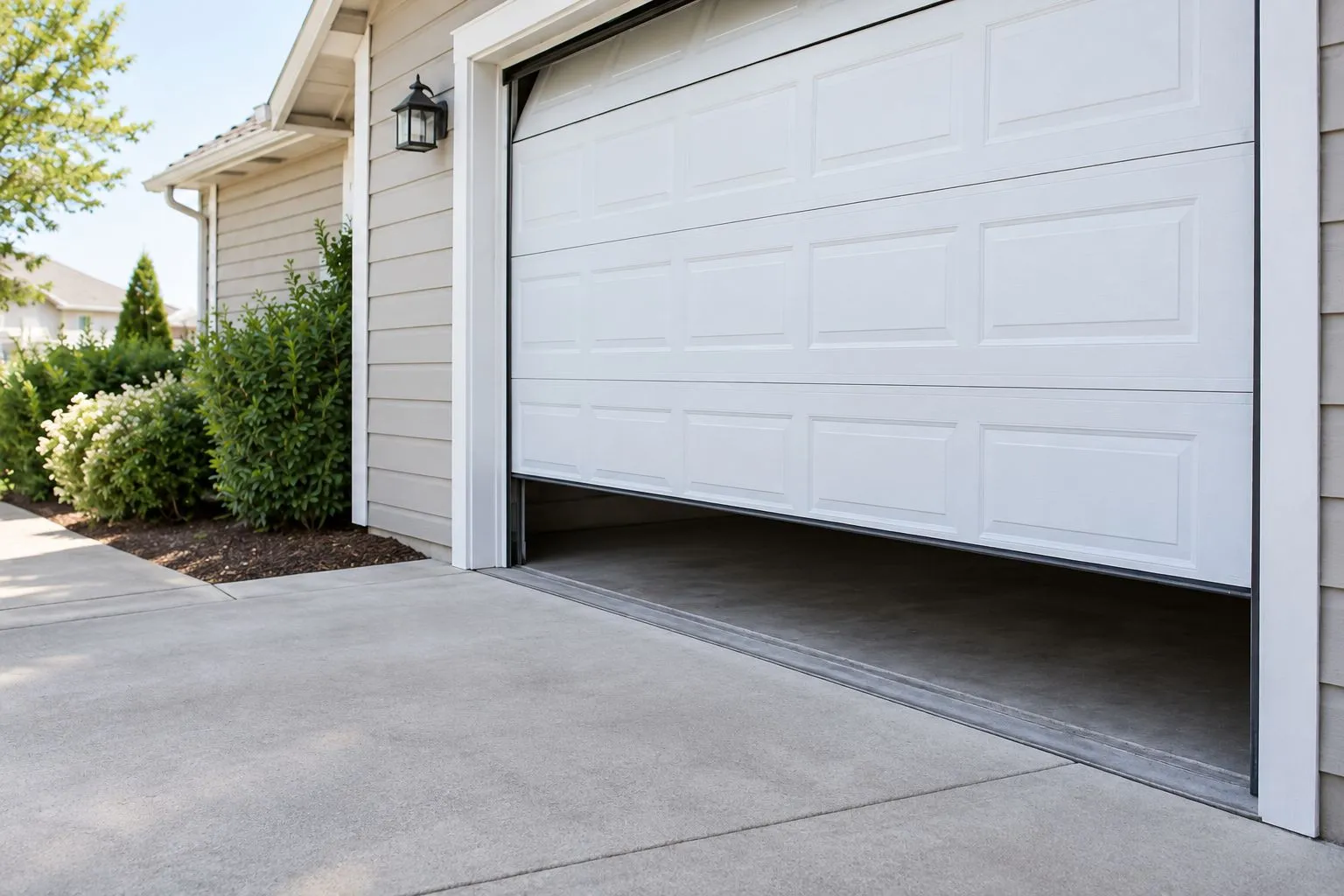
Illustrative photo: keep the area beneath a partly open door clear while arranging professional assessment.
Is a stuck-closed door safer than a partly open door?
A fully closed door keeps the opening covered, but it does not prove the mechanism is sound. A broken spring or jammed component can leave the door closed and difficult to lift. Do not use the closed position as permission to pull harder.
A partly open door adds exposure beneath a suspended load. Keep people out of that space and use another safe entrance if one is available. Do not place a ladder, bin, timber, or vehicle beneath it as an improvised support.
| Door condition | Best for | Main limitation |
|---|---|---|
| Fully closed, stable, no visible damage | Safe control checks from outside the travel path | Hidden mechanical faults remain possible |
| Partly open, apparently level | Observing and reporting the stopped position | The open space is not a safe passage |
| Crooked, damaged, or visibly unsupported | Keeping clear and requesting professional assessment | Homeowner operation or release can worsen the hazard |
These are triage categories, not diagnoses. Describe the condition when you call, and let the technician determine whether the door, opener, or both require work.
Why a garage door stops moving
The visible symptom does not always identify the failed component. An opener problem and a door problem can both produce silence, interrupted movement, or a door that remains closed. Use these categories to explain the situation, not to select parts yourself.
- Control or power interruption: A remote battery, control lock setting, or loss of opener power can prevent a command from reaching the system. Checking accessible controls is useful; electrical repair is not a homeowner troubleshooting step.
- Safety-sensor interruption: An obstructed sensor path can prevent closing on systems that use photoelectric sensors. It does not explain every failure to open, and bypassing sensors is not an acceptable fix.
- Spring or cable damage: Counterbalance components help support door movement. Visible damage requires professional attention because these components involve stored energy and suspended weight.
- Track, roller, or panel damage: A displaced roller, bent track, or damaged section can interfere with movement. Do not straighten components or loosen fasteners to test the theory.
- An obstruction or engaged lock: Objects and a manually engaged lock can stop movement. Do not ask the opener to overcome either condition, and do not approach locking hardware on an unstable door.
The useful distinction is safe control check versus mechanical repair—not remote problem versus wall-button problem. Both controls operate the same door, so changing how you command it does not remove a mechanical hazard.
Can you pull the emergency-release cord when the door is stuck?
Do not pull the emergency-release cord on a partly open, crooked, damaged, or otherwise unstable door. Disconnecting the opener can change what is holding the door in position, and a failed counterbalance system can allow uncontrolled movement.
For an apparently intact, fully closed door during a power interruption, follow the specific opener manufacturer’s instructions before considering manual operation. If the condition of the springs or cables is uncertain, leave the release alone and request professional help. Do not pull harder when the cord or door resists.
What if the opener runs but the garage door stays still?
Stop repeated attempts when the opener runs but the door does not move. Report whether you hear humming, clicking, or normal motor operation, but do not infer that the motor is the only failed component.
A technician needs to assess the door’s movement and the opener’s connection to it. Increasing opener force, reconnecting a questionable mechanism, or lifting while someone presses the control can turn an access problem into an injury risk.
Is garage door repair or replacement the better next step?
Choose an assessment before choosing a new door. A stuck door alone does not establish that replacement is necessary. The decision depends on the damaged components, the condition of the remaining door, and whether a safe repair is practical.
Ask Derby Strong to distinguish door repair, opener service, and new-door installation in the proposed work. These are different scopes. You need to know what restores safe movement and what addresses additional condition problems before approving either.
| Option | Best for | Benefit | Limitation |
|---|---|---|---|
| Garage door repair | A repairable fault in an otherwise usable door | Addresses the failed door components | Does not renew unrelated worn or damaged parts |
| Opener service | A fault traced to the opener or its controls | Addresses operation without automatically replacing the door | Cannot correct an unsafe door mechanism by itself |
| New-door installation | A door whose condition supports replacement after assessment | Replaces the door rather than patching its existing damage | Is unnecessary when a suitable repair resolves the problem |
Ask for the reason behind the recommendation, not just the proposed outcome. If replacement is recommended, ask which condition makes repair unsuitable. If opener work is recommended, ask whether the door mechanism has also been checked.
How to prepare for a Louisville service visit
Prepare information and access, not the mechanism. A clear account of the failure helps the technician understand the problem; partially dismantled hardware adds uncertainty and risk.
- Record the door’s current position and the last action before it stopped.
- Note which controls respond and whether the motor makes a sound.
- Take safe-distance photos of visible damage without standing underneath.
- Keep pets and other people away from the affected opening.
- Explain whether the stuck door blocks a vehicle, business access, or your only practical entrance.
- Move stored items only where you can do so without approaching the unstable door.
For a Louisville business, tell the service provider whether the affected opening is a commercial overhead door. Keep loading activity away from it and establish another safe access arrangement if available. Do not transfer residential opener instructions to a commercial operator.
If you are a tenant, notify the property manager about access and repair authorization while keeping the area clear. If the garage is attached to your home, secure other accessible entrances without trying to force the stuck door closed.
Frequently Asked Questions
What should I do first when my Louisville garage door will not move?
Stop operating the door and keep people away from its travel path. Check accessible controls only if the door appears stable and has no visible mechanical damage; otherwise arrange professional repair.
Is a stuck garage door always an emergency?
A stuck garage door is not automatically an immediate safety emergency. Injury, entrapment, smoke, or unstable movement requires urgent safety action; a stable closed door still needs assessment when access or security is affected.
Can I open a garage door with a broken spring?
Do not attempt to open a garage door with a suspected broken spring. Stop using the opener and leave spring, cable, and counterbalance work to a professional.
Should I keep pressing the remote if the door does not move?
No—stop repeated commands when the door fails to move, strains, or makes unusual sounds. Record the response instead of increasing force or trying another control repeatedly.
Can I fix a garage door cable that has come loose?
Do not handle or reconnect a loose garage door cable yourself. Keep clear of the door and arrange professional assessment of the cable and associated mechanism.
Does a stuck garage door mean I need a replacement?
A stuck garage door does not by itself justify replacement. Ask for an assessment that separates a repairable component fault from damage or condition problems that support installing a new door.
Does Derby Strong provide garage door service in Louisville?
Derby Strong provides garage door repair, installation, and opener service for Louisville homeowners and businesses. Confirm scheduling and the appropriate service scope directly rather than assuming a response time.
One Last Thing Before You Decide
Do not test the door again just to make a better video for the technician. Record the stopped position, describe the last movement, and leave it alone. Useful evidence should not require recreating an unsafe event.